
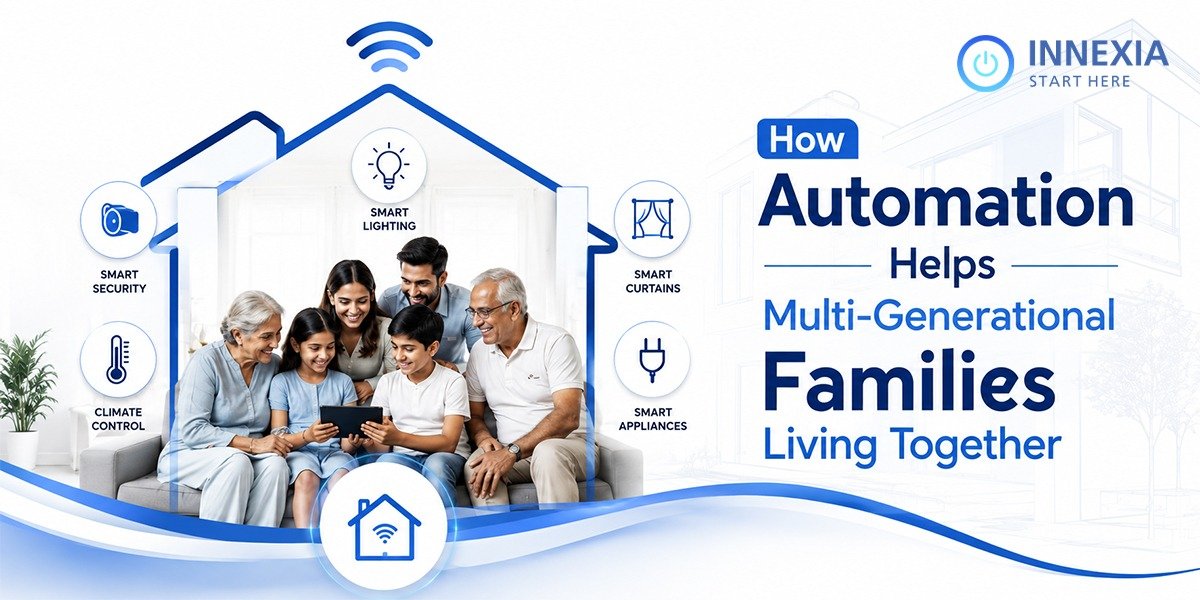
The Indian joint family is not going away. If anything, it is coming back. Multigenerational living has emerged as one of the leading trends reshaping India’s residential real estate sector in 2026, with inclusive and flexible living spaces becoming a priority for developers and buyers alike. Urban families are choosing to stay together, not out of financial necessity alone, but because the joint family structure genuinely works when the home supports it.
The challenge is that a home shared by grandparents, working parents, and children has three completely different sets of needs running simultaneously. Different schedules, different comfort preferences, different relationships with technology, and different ideas about what privacy means. A home that works for all of them without asking anyone to compromise is not easy to design.
Smart home automation makes it possible. Not by adding complexity, but by removing friction.
What Multi-Generational Living in India Actually Looks Like
Before talking about solutions, it helps to be honest about the real texture of multi-generational households in India. The grandparents get up early in the morning. They have a routine they do at the morning and specific light preferences, and often are intimidated by new technology. Parents get up early to go to work and return late and prefer security and convenience when they are away. The children go to school and they have a totally different relationship with technology than anyone else in the house.
The concept of living with multiple generations has shifted from the past and evolved to a more flexible, private and technology-based model. The house must be able to handle all of the above at once without causing confusion or forcing anyone to adopt someone’s system of organization. That’s where Family Automation really shines.
How Smart Home Automation Solves the Core Challenges
One Home, Multiple Comfort Preferences
The most immediate tension in multi-generational households is climate and lighting. Grandparents often want warmer lighting and higher AC temperatures. Children want the lights on everywhere. Working adults want everything switched off when rooms are empty to save electricity.
Smart home automation resolves this without negotiation. Different rooms can have completely different settings running simultaneously. The grandparents’ bedroom maintains their preferred temperature and lighting schedule automatically. The children’s study gets bright cool lighting during homework hours and dims when they leave. The living room adjusts based on occupancy so nobody has to remember to switch anything off.
Nobody has to agree. The home accommodates everyone separately.
Security That Works for the Whole Family
Security is one of the biggest concerns in multigenerational living in India, and it is more layered than people expect.
Working parents want to know the front door is locked while they are at the office. They want to see who rings the bell when only the grandparents are home. They want to know when the children arrive back from school. Grandparents want to feel safe without operating complex systems.
Smart home automation handles each of these without any family member needing to do anything manually. The video door phone sends a live feed to every family member’s phone the moment someone rings. The smart door lock sends a notification when the children arrive home and use their code. The smart lock can be given a temporary PIN for the domestic help that expires automatically. Nobody needs to be physically present to manage any of it.
Access Control That Respects Everyone
In a multi-generational household in India, access management is not a simple problem. The domestic help has set hours. Grandparents should not need to get up to let someone in. Parents need to grant and revoke access remotely. Children need a way to enter without carrying a key that can get lost.
Family automation solves this through layered access. Grandparents use the existing switch or a simple voice command. Children have their own PIN on the smart lock. Working adults control everything remotely through the app. The domestic help gets a scheduled code that only works during their permitted hours. Every entry is logged with a timestamp, so anyone in the family can see the activity at any time.
Voice Control for Elders
This is the most underappreciated benefit of smart home automation for multigenerational families in India.
Elders do not have to use a smartphone to benefit from automation. Voice-controlled home automation gives them complete control of lighting, fans, and AC without touching any device. They speak naturally, and the home responds. For elders with reduced mobility, this is not a convenience feature. It is a meaningful quality-of-life improvement that also reduces dependence on other family members for simple tasks.
The family automation system supports every control method simultaneously: voice, app, existing wall switch, and remote. Every family member uses what is most comfortable for them, and the system treats all of them equally.
Energy Management Across a Larger Household
The energy use of multi-generational households is, and sometimes very significantly, greater than that of nuclear households. As more people use more rooms, more appliances are being used, and more chances are being created for things to be left on unnecessarily.
Smart home automation offers discipline for energy management without the need for any one person to actively oversee it. Rooms automatically turn off when no one is present. The AC reduces when there’s no one in a zone. You can set the time for appliances to operate when it is not busy. A household of 6 people can generate enough electricity savings by simply avoiding energy losses when the house is empty.
What Family Automation Looks Like Room by Room
Living room: Shared space, multiple preferences. Automation sets scenes based on time of day. Evening lighting is warm and comfortable for the grandparents. Afternoon lighting is bright and functional during children’s activities. The TV area adjusts automatically when you use a movie.
Kitchen: Activity-based lighting which turns on/off when a person is in the kitchen. Energy smart scheduling of appliances.
Grandparents’ room: Their own time, their own choice, and their own lifestyle, separate from the family. Use voice recognition rather than an app. Emergency alert in case of emergency.
Children’s room: Study lighting schedules aligned with school timings. Door sensor notification when they arrive home. Parental app visibility into when the room light goes on and off.
Main entrance: Smart door lock with multi-user PIN management. Video door phone with live feed to every family member. Activity log showing every entry throughout the day.
Common areas: Occupancy-based lighting so hallways, bathrooms, and utility areas are never left on unnecessarily.
Why Automation for Multigenerational Families Works Better Than DIY Products
A collection of smart bulbs from one brand, a smart speaker from another, and a doorbell from a third does not create family automation. It creates chaos with three different apps and no shared logic.
What actually works in multigenerational households is a unified system where every device communicates through one platform and every family member can interact with it in the way that suits them. The grandparents’ voice command, the parent’s app notification, and the child’s PIN entry all flow through the same system and update the same activity log.
This is why professional installation from a home automation company matters more in multi-generational homes than anywhere else. The system needs to be configured thoughtfully, not assembled from a shopping cart.
How Innexia Serves Multi-Generational Households in India
We designed our system with Indian families in mind from the start, which means we designed it for the joint family structure specifically.
We have developed a smart home automation system which allows simultaneous control using five different methods, such as existing wall switches, voice command, mobile app, RFID cards, and Magic Cube. All family members utilize the same method at their comfort level and none of the functionality is compromised.
Our installation crew can set up in about 4 hours without any renovations. It’s a retrofit system and uses the existing wiring and switches in your home. Grandparents don’t have to get up to speed on the switch’s capabilities.
Every installation includes a 5-year piece-to-piece replacement warranty. Not because something will go wrong, but because a family depending on a system for daily life needs to know the support is there for the long term.
Conclusion
Family automation solves that challenge systematically. Not by forcing everyone to use a smartphone or learn a new technology, but by making the home itself intelligent enough to serve everyone on their own terms.
At Innexia, our smart home automation is designed specifically for how Indian families actually live. Multi-generational households across Ahmedabad, Gandhinagar, and cities across India are already living more comfortably, more securely, and with less daily friction because the home works for everyone in it.
Visit innexia.in to book a free demo and see what family automation looks like in your home.