
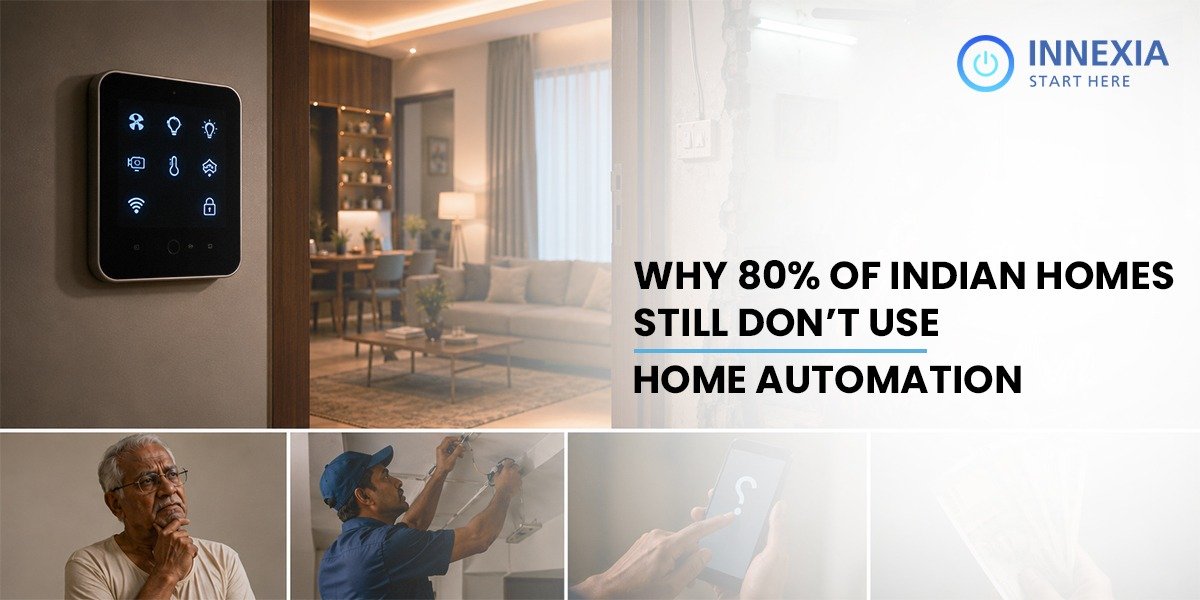
India has over 900 million internet users. We have the world’s cheapest mobile data. We adopted UPI faster than almost any country on earth. And yet, the vast majority of Indian homes still operate the same way they did twenty years ago, with manual switches, physical keys, and zero automation.
Metropolitan cities such as Bangalore, Mumbai, and NCR currently lead smart home adoption, with a 35% penetration rate in new constructions, while Tier-2 cities are witnessing the fastest growth at an impressive 45% year-over-year.
This blog is about why. Not the marketing version. The real reasons Indian families have not made the move to home automation in India and why that is starting to change.
What Is Home Automation in India?
Home Automation: Home automation in India refers to the use of connected devices, IoT home automation technology, and smart systems to control lighting, security, climate, and access remotely or automatically through a single app, voice commands, or preset routines. A complete home automation system does not require you to change your wiring or rebuild your home. It works with what you already have.
The gap between what home automation actually is and what most Indians think it is, that gap alone explains a significant portion of the 80%.
Reason 1: People Think It Is Only for the Rich
This is the most persistent misconception in the Indian market, and it has deep historical roots.
A decade ago, home automation in India was genuinely expensive. Full-system installations ran into several lakhs. The only people who had it were builders of luxury bungalows or tech enthusiasts with deep pockets. That image stuck. And it stuck hard.
Today, the reality is completely different. Entry-level smart home solutions start at under Rs. 10,000 for a basic setup. A complete home automation system for a 3 BHK, covering lighting, security, and access control, starts at a fraction of what most families spend on a television. The perception has not caught up with the price reality.
The biggest irony is that home automation in India now saves money over time. A smart lighting system and smart security system working together can cut electricity bills by 20 to 35%. For most households, the system pays for itself within a few years. The families avoiding it because it seems expensive are the same ones who would benefit most from its savings.
Reason 2: The Fear That It Will Stop Working
This one is genuinely Indian. And it is a fair concern.
Power cuts. Voltage fluctuations. Wi-Fi dead zones in concrete homes. ISP maintenance windows at midnight. Indian electrical infrastructure has its realities, and any technology that depends on perfect conditions is not going to survive in most Indian homes.
The concern many families have is simple: what happens when the internet goes down? Can I still open my front door? Will the lights still work?
The answer, with the right system, is yes. Home automation systems built on Zigbee mesh technology do not depend on internet connectivity for their core functions. Devices communicate locally with each other and with a central hub inside the home. When the router goes down, the smart home ecosystem keeps working. Schedules run. Voice-controlled home automation continues responding. Smart lighting stays on schedule.
This is not a feature that every system offers. It is a specifically Indian design consideration. Systems built for markets with reliable connectivity do not prioritize this. Systems built for India, like ours, do.
Reason 3: People Think They Need to Rewire Everything
This misconception has stopped more installations than any other single factor.
The image most families have is of workers opening walls, running new wires, and disrupting the home for weeks. It is a renovation, not an upgrade. And nobody wants a renovation.
Modern home automation systems in India are retrofitted by design. Nothing is torn out. No walls are open. No existing wiring is replaced. The system installs over what is already there, with expert technicians completing a full setup in approximately four hours. The home is smart before the day ends.
This is not a compromise. Retrofit systems using wireless protocols are actually more flexible, easier to expand, and more resilient than hardwired alternatives. The limitation is entirely in the perception.
Reason 4: Lack of Awareness About What It Actually Does
Most people’s mental model of home automation in India is voice-activated lights and talking refrigerators. That is a narrow and honestly unhelpful frame.
The actual value of a home automation system is much more grounded. It is knowing your door is locked when you are at the office. It is the domestic help being granted access at exactly the hours they need, with that access automatically expiring. It is getting a notification on your phone when a door sensor detects your front door opening at 2 am. It is your smart security system recording the exact moment anyone enters or leaves your home.
These are not luxury conveniences. They are practical, daily-life improvements that address real anxieties that Indian families live with. The smart living solutions that actually shift behaviour are the ones solving problems people already feel, not demonstrating technology for its own sake.
The awareness problem is a combehaviorn problem. Most people have never had anyone explain what home automation in India would look like, specifically in their home, for their family, and with their existing layout.
Reason 5: Worry About After-Sales Support
In India, after-sales service can make or break a technology product entirely.
Families who adopted early smart home devices from international brands often ended up with products that became unsupported within a few years, app updates that broke functionality, or hardware failures with no local technician available. That experience travels. When a family member or neighbor has a bad experience, the story spreads.
The concern is legitimate. An IoT home automation system integrated into your home’s lighting, security, and access control is not something you can casually replace. It needs ongoing support from people who know the system.
This is why choosing a home automation company in India with a physical presence, onsite support, and a clear warranty matters more than any feature specification. A 5-year piece-to-piece replacement warranty is not just a product promise. It is a statement that the company intends to stand behind the installation for the long term.
Reason 6: Multi-Generational Homes
This is a uniquely Indian barrier that most international home automation brands have never considered.
The average Indian household has multiple generations living together. Grandparents, parents, children, and sometimes extended family. The assumption that everyone in the house is tech-comfortable enough to use a smartphone app to control lights is simply wrong for most Indian families.
The smart home ecosystem that works in an Indian home works for everyone without requiring everyone to change their behavior. Grandparents should be able to use the same switch they have always used. Children can use voice-controlled home automation. Working adults can use the app. Guests can be given a temporary PIN.
A properly designed home automation system does not replace how people already use their home. It layers on top of it, giving each person the interface that works for them while keeping everything connected behind the scenes.
What Is Actually Changing in 2026
The barriers are real. But so is the shift.
India’s home automation market is growing because the product reality has finally begun to match what families actually need. Systems designed for Indian electrical conditions. Retrofit installations that do not require renovation. Voice-controlled home automation that works in Hindi and regional languages. Smart security systems that address genuine security anxieties rather than imported use cases.
The families making the move today are not early adopters taking a risk. They are pragmatic homeowners who have seen enough evidence, in the form of neighbors, friends, and online reviews, to trust that the technology works and the support is real.
The 80% who have not yet adopted home automation in India are not resistant. Most of them are simply waiting for someone to show them what it would look like in their specific home, for their specific family, with their specific concerns addressed.
Conclusion
The 80% of Indian homes that have not adopted home automation are not making a rational choice based on the current reality of the technology. They are responding to an outdated picture of what home automation in India looks like: expensive, complicated, unreliable, and designed for someone else.
The current reality is different. Retrofit systems. Four-hour installations. IoT home automation that works through power cuts. Smart home solutions designed around multi-generational Indian families. Voice-controlled home automation in Indian languages. Smart security systems that address real safety concerns.
The gap between perception and reality is the only thing standing between most Indian families and a genuinely smarter home.
At Innexia, we have spent 23 years building automation systems for real environments with real constraints. Our home automation system is designed specifically for how Indian homes actually work.
Book a free demo and see what home automation in India looks like in your home.