
Every growing business eventually asks the same question. Do we stick with what has always worked, or do we invest in modern office technology that costs more upfront but promises to pay off over time?
The smart office vs traditional office debate is not just about gadgets and convenience. It affects your electricity bill, your employees’ daily experience, your security, and increasingly, your ability to compete for talent. This blog breaks down where the two approaches differ and which one makes sense for your business.
What Is a Traditional Office?
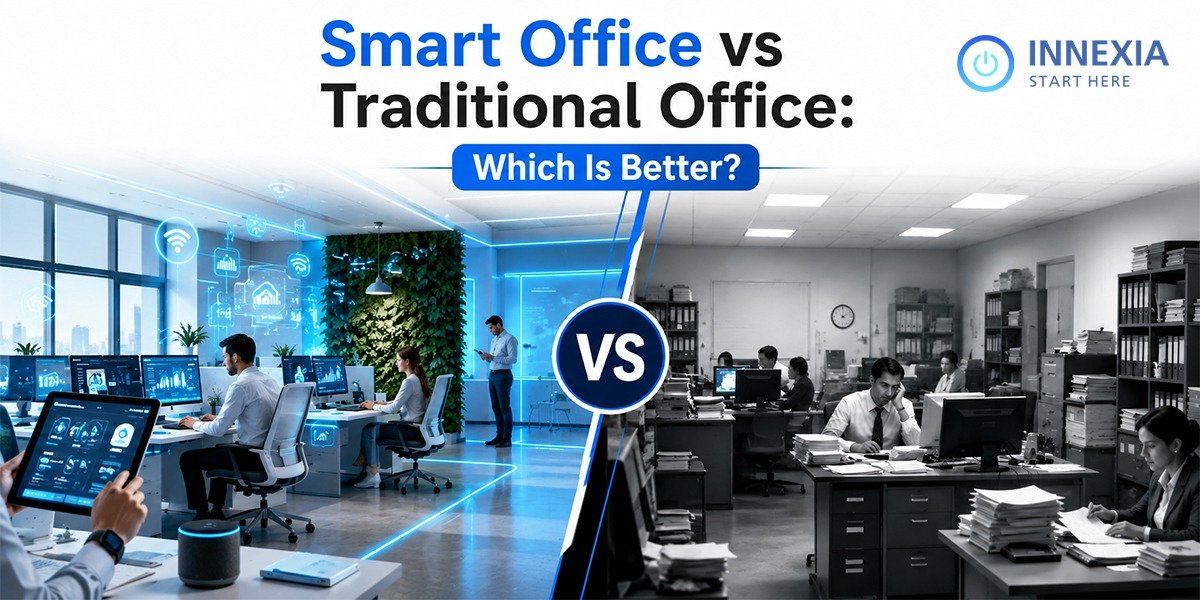
Manual processes are the key features of a traditional office. Manual switch-on and switch-off of the lights. The AC operates on a set schedule, irrespective of the number of people present in the building. Access control is someone checking IDs or a physical key changing hands. Each system is separate, and there is no data linkage between systems.
This model is simple and familiar, and for that reason, has been successful for decades. But simplicity comes at a cost, and that cost shows up in your electricity bill, your security gaps, and the hours your team spends on tasks that could run themselves.
What Is a Smart Office?
A smart office in India or anywhere, for that matter, is responsive and not static, with the help of connected sensors, automated systems, and centralized software. Occupancy-adjusted lighting. Climate control: reads real-time conditions, not a fixed time. Access control automatically logs all access. All systems don’t function in isolation but rather by using one system.
Smart office technology is the umbrella term for the various systems, sensors, software, and Artificial Intelligence (AI) devices and tools that help to make physical workplaces more efficient, responsive, and data-driven. Selecting a smart office in India implies accepting the modern office technology designed explicitly for the day-to-day working of Indian businesses.
Energy Costs: Where the Difference Is Most Visible
This is where smart office solutions in India deliver the fastest, most measurable return.
Smart HVAC systems cut energy use by up to 50 percent, and occupancy-based lighting has reduced lighting costs by 25 percent or more in real deployments. A traditional office running lights and AC on fixed schedules wastes energy every single day in empty meeting rooms, unused floors, and after-hours periods when nobody is present.
A smart office corrects this automatically. Sensors identify if a room is empty and help with the lighting and climate settings accordingly, without requiring people to remember. In India, with the continuously increasing rates of electricity, this single difference is enough in itself to make the investment worthwhile.
Employee Experience and Productivity
Conventional offices require changes to accommodate fixed conditions. The same light levels, the same temperature, all day long, no matter who is there or what they are doing.
Modern office technology flips this. Climate zones adjust based on actual occupancy. Meeting rooms release themselves automatically when nobody shows up for a booked slot. Staff work more effectively on their tasks and spend less time in their physical environment.
Employee experience has become the primary design objective for modern office technology in 2026, with operational efficiency treated as a valuable by-product rather than the sole justification. This shift matters because employees notice when a workplace works for them versus when they are simply expected to adjust to it.
Security and Access Control
A traditional office typically relies on physical keys, ID checks at reception, or a basic swipe card system. These work, but they leave gaps. Lost keys are a security risk. Reception staff cannot monitor every entry point simultaneously. There is no easy way to know exactly who accessed which area and when.
A smart office in India solves this through integrated access control. All doors, lobby doors, server rooms, and office doors are automatically monitored and logged. Access is granted or denied in an instant, without changing locks. Visitor management is now digital, and once a visitor arrives, they are recorded, and hosts are notified.
This type of control isn’t a luxury for businesses that deal with sensitive information or valuable equipment. It is something that everyone should be able to do by 2026.
Setup Cost and Long-Term Value
The upfront cost comparison is where most businesses hesitate, and it is a fair concern.
A traditional office setup is cheaper to install initially. A simple manual switch, some wiring, and a standard lock are cheaper than a comprehensive smart office system. However, that’s just part of the picture.
Smart office solutions in India usually give a return on investment in terms of energy savings, administrative cost savings, and long-term maintenance expenses. Combined with the savings in electricity usage of 25 to 50 percent, the reduced requirement for manual monitoring staff, and the reduction in security incidents, the total cost of ownership can actually benefit the smart office solution within a few years of its installation, often before that and depending on the size of the space.
Scalability and Flexibility
Traditional offices are not flexible by nature. The installation of a new floor, access control, or other systems usually requires the addition of new wiring, new hardware, and disruption.
A well-architected smart office platform will be modular. It is possible to add new sensors, new access points, and new zones without ripping out anything from the field, as long as it was designed all at once with a unified architecture. These will make a huge difference if your company is a growing one and you don’t want to redo your entire office layout each time.
Which One Is Actually Better?
The truth is, it all depends on your business size, budget, and priorities, but the trend is quite clear.
The global smart office market will reach about 61 billion dollars in 2025 and is projected to more than double by 2026 and further increase by more than double by the end of the decade. Businesses are not going through this change simply because it’s in fashion. Their focus is on making them, as the numbers on energy, security, and productivity always seem to be on their connected systems side.
If you have a small business with only one room and few customers, you might need a standard arrangement. However, when it comes to managing multiple rooms, fluctuating occupancy, and increasing energy bills, smart office solutions in India prove to be game-changers.
How Innexia Helps Businesses Make the Shift
Smart Office Solutions in India that we design are for businesses that are interested in results, not demos.
Each component of your office works collaboratively; it’s all integrated within a single system, combining lighting, climate control, access control, and energy monitoring. Our expert installation staff finish the job with little impact on the day-to-day operation, and every deployment comes with our warranty and support.
Many businesses in Ahmedabad, Gandhinagar, and across India are already on our platform, enjoying reduced electricity costs, better security, and truly better working conditions for those who use them.
Conclusion
The smart office vs traditional office comparison is no longer a close call. Energy savings, tighter security, better employee experience, and long-term cost efficiency all point in the same direction. Traditional setups still have a place for very small, low-complexity spaces, but for any business planning to grow, a smart office in India delivers returns that are difficult to ignore.
At Innexia, we help businesses across India make this transition without disruption or guesswork, backed by 23 years of automation expertise and a platform built specifically for how modern workplaces actually operate.