
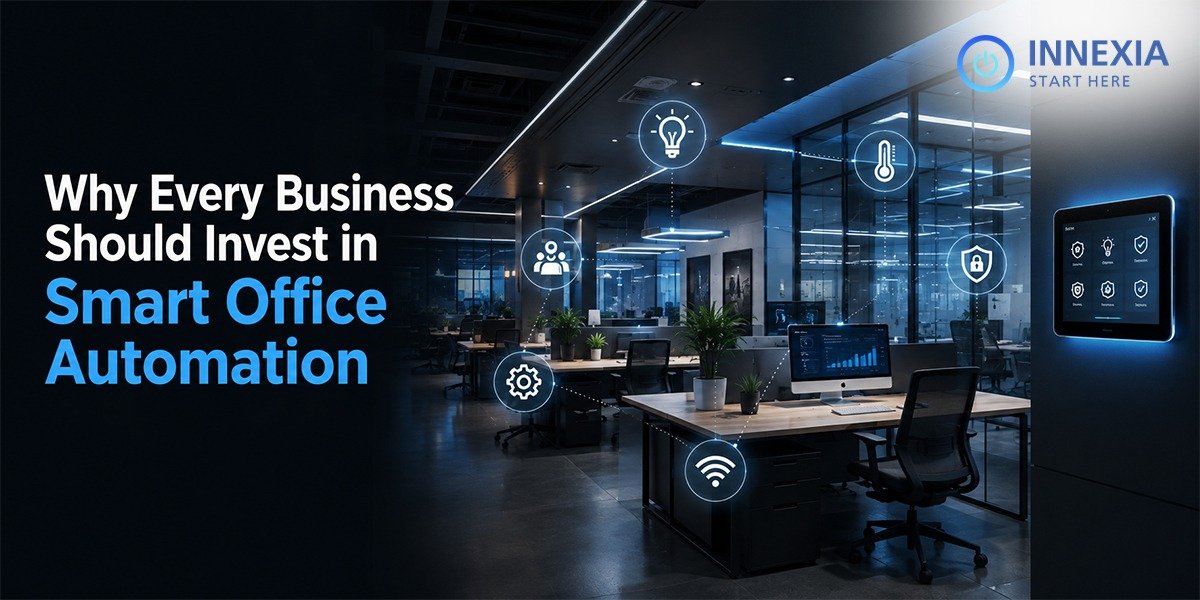
Every business owner eventually faces the same tradeoff. Spend more upfront on infrastructure that runs itself, or keep paying the ongoing cost of manual processes that quietly drain time, money, and attention every single day.
Smart office automation has moved past the experimental stage. It is now a measurable, calculable business decision. Automation typically delivers positive ROI within 60 to 90 days for businesses that start with the right systems, with median payback periods well under a year. For office environments specifically, the numbers are even more compelling once energy, security, and productivity gains are factored in together.
This blog lays out exactly why office automation in India is becoming a baseline expectation rather than an optional upgrade and what it actually delivers for businesses that make the shift.
The Energy Case Alone Justifies the Investment
If nothing else convinces you, the energy numbers should.
Buildings account for roughly 30 percent of the world’s final energy consumption, and lighting and HVAC represent the largest operational loads in most commercial spaces. A traditional office runs both on fixed schedules regardless of actual occupancy, which means significant energy waste happens every single day without anyone noticing.
Smart office automation eliminates this waste automatically. Occupancy sensors detect when a room is empty and adjust lighting and climate control in real time. Predictive systems can pre-condition zones based on calendar data and historical patterns rather than reacting after people arrive. For businesses in Ahmedabad, Gandhinagar, or anywhere else that are managing rising electricity tariffs, this single category of savings often covers a meaningful portion of the total investment in the first year.
Automation Coordinates What Manual Processes Cannot
The real value of smart office automation is not any single device. It is coordination.
A motion sensor can provide light shut-off in an empty room. However, a coordinated system can do much more by altering the setpoint temperature, freeing up an unused meeting room for other use, shutting off unnecessary venting, and recording the avoided energy savings. None of this happens with disconnected devices working in isolation.
This is the fundamental difference between buying smart office equipment and implementing smart office automation as a system. A business that installs a smart thermostat and a motion sensor separately gets marginal improvement. A business that connects lighting, climate, access control, and booking data through a single platform gets compounding returns because each system informs the others.
Security Improves Without Adding Headcount
The traditional way of securing a workplace relies on several manual steps, such as having an ID checked at the door, someone remembering to lock a server room, someone losing a physical key, and so on.
In India, office automation now also involves the integration of access control that eliminates the need to continuously monitor people. All entry points are automatically monitored and logged. Access is granted or denied immediately, without altering any locks. Visitor management goes digital, notifying the host as soon as the visitor arrives—not by a phone call from a front desk.
This isn’t a luxury feature for businesses that have sensitive client data or valuable equipment or just want a more effective accounting system as they expand. Risk reduction is self-paying for the first time; it prevents an incident.
Employee Experience Is Now the Primary Justification
For years, smart office automation was sold purely as a cost-cutting tool. That framing has shifted, and for good reason.
Modern automated systems create environments that respond to actual conditions rather than forcing employees to adapt to fixed, one-size-fits-all settings. Climate zones adjust based on who is actually in the room. Meeting rooms release themselves automatically when nobody shows up, freeing the space for someone who actually needs it. Employees spend measurably less time managing their physical environment.
Businesses competing for talent are finding that a workplace that visibly works for its people, rather than the other way around, has become a genuine differentiator. This matters as much for retention as it does for the electricity bill.
The ROI Numbers Are No Longer Theoretical
Business leaders considering smart office automation in India are right to ask for hard numbers before committing budget.
Across small and mid-sized businesses more broadly, automation implementations are showing a median first-year ROI of 340 percent, with payback periods averaging around two to three months for straightforward deployments. Office automation specific to energy, security, and space management follows a similar pattern, particularly for businesses with multiple rooms or floors where manual oversight becomes genuinely difficult to maintain consistently.
The gap between businesses using coordinated automation and those relying entirely on manual processes is no longer marginal. It has become a structural competitive difference in how efficiently a business can operate.
Getting Started Without Overcommitting
The mistake most businesses make with smart office automation is trying to do everything at once.
The better approach is a phased rollout focused on the highest impact areas first. Start by identifying which existing systems in your office are not communicating with each other: lighting that runs independently of occupancy, climate control on a fixed schedule regardless of actual usage, access control still dependent on physical keys or manual checks. These holes generally directly lead to the most cost-effective first step.
The next step is to scale up what works, not drastically change it, to become a full-blown, unified platform.
How Innexia Supports Businesses Across India
We create office automation in India for businesses looking for results, not techno-talk.
Every element of our system is connected and not separate, like a light, a climate control, an access and an energy monitoring. Our smart office automation Ahmedabad and office automation Gandhinagar solution begins with understanding the way your particular business actually functions before recommending something.
Every installation is completed by our expert team with minimal disruption, and every deployment includes ongoing support backed by a warranty that reflects our confidence in the hardware we install.
Conclusion
The case for smart office automation is no longer built on speculation. Energy savings, tighter security, measurable ROI, and better employee experience all point toward the same conclusion. Businesses that continue running on manual, disconnected systems are absorbing costs that automated competitors have already eliminated.
At Innexia, we help businesses across India, from Ahmedabad to Gandhinagar and beyond, make this shift without disruption or guesswork, backed by 6 years of automation expertise and a platform built for how modern businesses actually operate.
Book a free demo and see what smart office automation can do for your business.