
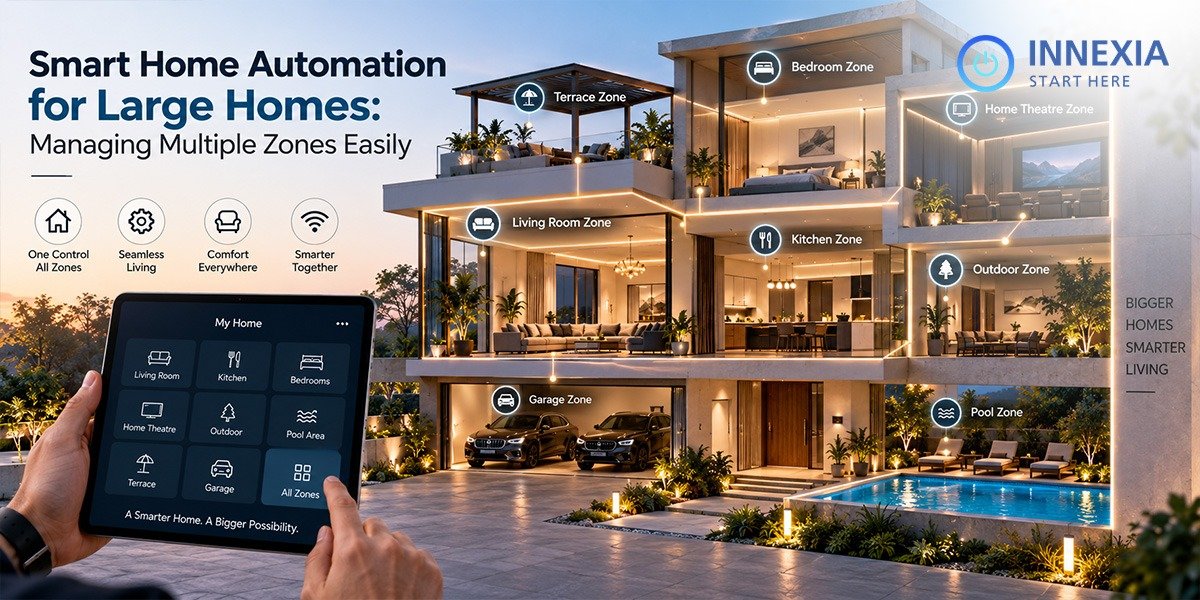
Managing a large home can be very different from managing a compact apartment. With multiple bedrooms, living areas, kitchens, balconies, entertainment spaces, outdoor areas, staff rooms, and other zones, controlling everything manually can quickly become inconvenient.
This is where a well-designed smart home automation system can make a significant difference. Instead of controlling every room separately, homeowners can connect different areas of the property and manage them through a centralized smart home control system.
For large villas and luxury residences, multi-zone home automation provides a practical way to organize lighting, climate control, curtains, security, entertainment, and other smart devices according to individual areas of the house.
If you are planning Smart Home automation in Ahmedabad, working with an experienced smart home automation company during the design and installation process can help ensure that all zones work together smoothly.
What Is Multi-Zone Home Automation?
Multi-zone home automation means dividing a large property into different functional areas or “zones” and giving each zone its own automation controls and routines.
For example, a large villa could have:
- Entrance and driveway zone
- Living room zone
- Dining zone
- Kitchen zone
- Master bedroom zone
- Children’s bedroom zone
- Guest bedroom zone
- Home office zone
- Entertainment zone
- Outdoor zone
- Garden and landscape zone
- Poolside zone
- Security zone
Each area can have different automation requirements.
The living room might require lighting, curtains, AC and entertainment control, while an outdoor area may mainly need lighting, security sensors and automated schedules.
A properly designed system brings these different zones together while still allowing homeowners to control each area independently.
Why Do Large Homes Need Smart Automation?
In a smaller home, manually switching lights, adjusting the AC, closing curtains, or checking individual rooms may not feel particularly difficult.
In a large property, however, the number of devices and rooms increases significantly.
Imagine a house with:
- 30+ lighting points
Multiple air-conditioning units - Several motorized curtains
- Security sensors
- Smart locks
- Entertainment systems
- Outdoor lighting
- Multiple access points
- Several floors
Managing everything individually can become time-consuming.
A smart home automation system simplifies this by allowing multiple devices to respond to a single command, schedule, sensor, or predefined scene.
For example, a homeowner can create an Away Mode that switches off selected lights, adjusts climate settings, closes curtains, and activates security-related functions without manually visiting every room.
How Does Multi-Zone Home Automation Work?
The foundation of a multi-zone system is centralized communication between smart devices and the control platform.
Depending on the technology and requirements, a system may include:
- Smart switches: Control lights and selected electrical loads.
- Sensors: Detect motion, doors/windows, temperature, or other conditions.
- Smart locks: Manage access to specific entry points.
- Motorized curtains: Automate opening and closing according to schedules or scenes.
- Smart AC control: Manage temperature and climate settings.
- Central hub: Connects and coordinates compatible smart devices.
- Mobile application: Allows homeowners to monitor and control connected devices.
This creates a connected environment where individual zones can operate independently while remaining part of one larger automation ecosystem.
Creating Different Zones for Different Lifestyles
One of the biggest advantages of home automation for large houses is customization.
Not every family uses every part of the property in the same way.
Living Room Zone
The living room is usually one of the most frequently used spaces.
A smart setup can combine:
- Lighting control
- AC control
- Motorized curtains
- Television and entertainment
- Scene-based automation
A “Movie Mode,” for example, could adjust the lights and curtains while preparing the entertainment environment with one command.
Bedroom Zone
Bedrooms can be designed around comfort and daily routines.
A Good Morning scene could gradually open curtains and turn on selected lights, while a Good Night scene could switch off lights, close curtains, and adjust connected devices.
Kitchen Zone
Kitchen automation can focus on lighting, appliance management, sensors, and convenience.
Motion-based lighting can also be useful in areas where homeowners frequently move between spaces.
Outdoor Zone
Large homes often have gardens, balconies, terraces, driveways, and pool areas.
These can be treated as separate zones for:
- Landscape lighting
- Motion detection
Security - Outdoor entertainment
Scheduled lighting
This prevents the entire property from being treated as one single automation area.
Centralized Control Without Losing Individual Control
One common concern with large smart homes is complexity.
If every zone has a different application, remote control, and interface, automation can actually become confusing.
A properly designed smart home control system aims to simplify this.
Homeowners can have centralized control while still maintaining individual zone control.
For example, a single interface could provide access to:
- Ground Floor – Living, dining, kitchen and guest areas
- First Floor – Bedrooms and family lounge
- Second Floor – Office and entertainment spaces
- Outdoor – Garden, terrace, driveway and pool
This structure makes it easier to find and control specific areas.
Smart Scenes Make Large Homes Easier to Manage
Scenes are particularly useful for large properties because they allow several actions to happen together.
Instead of controlling individual devices, homeowners can create predefined routines.
Welcome Home
When you arrive:
- Entrance lights turn on
- Selected indoor lights activate
- Curtains respond according to the time
- AC can be adjusted
- Security mode changes according to the configured routine
Good Night
At bedtime:
- Selected lights switch off
- Curtains close
- Outdoor security lighting remains active
- Doors can be checked or locked
- Selected appliances can be turned off
Away Mode
When leaving:
- Selected lights switch off
- AC settings can be adjusted
- Curtains can be controlled
- Security devices can be activated
- Selected appliances can be turned off
The exact actions depend on the homeowner’s requirements and the devices installed.
Security Across Multiple Zones
Security becomes increasingly important as the size of a property increases.
Instead of monitoring only the main entrance, a multi-zone automation setup can help organize security across different areas.
For example:
- Main entrance sensors
- Garage monitoring
- Door and window sensors
- Motion sensors
- Smart locks
- Outdoor lighting
- Mobile notifications
A homeowner can organize these devices by zone and receive relevant alerts.
For example, a notification related to the garage can be distinguished from an alert associated with a bedroom window.
This creates a more organized approach to residential security.
Energy Management in Large Homes
Large houses can have significantly more electrical equipment than smaller residences.
Lighting, air conditioning, appliances, entertainment systems, and outdoor equipment can all contribute to energy consumption.
Automation can help homeowners manage these systems more systematically.
For example, lights can be scheduled according to occupancy or time, while connected climate systems can be managed according to predefined routines.
Motion and occupancy sensors may also help prevent certain lights from remaining switched on unnecessarily.
Automation does not automatically guarantee energy savings, but intelligent scheduling and device management can help reduce avoidable usage.
Why Professional Planning Matters for Large Homes
A large smart home is more than a collection of smart devices.
The system needs to be planned around:
- Property size
- Number of floors
- Electrical infrastructure
- Wi-Fi and network coverage
- Number of devices
- Automation requirements
- User preferences
- Future expansion
This is why selecting the right smart home automation company is important.
A professional team can assess the property, understand how different areas will be used, recommend suitable technologies, and plan how different devices should communicate with each other.
Poor planning can result in connectivity problems, inconsistent device control, unnecessary equipment, or a complicated user experience.
Smart Home Automation in Ahmedabad
As more homeowners invest in modern villas and larger residential properties, demand for connected home technology continues to grow.
For homeowners looking for Smart Home automation in Ahmedabad, Innexia provides smart home solutions designed to connect different aspects of residential living.
The Innexia ecosystem includes smart home components such as smart switches, sensors, smart locks, motion sensors, door/window sensors and other connected devices. Its solutions can be configured around different automation requirements and property layouts.
For large homes, the focus should not simply be on installing the maximum number of smart devices. Instead, the objective should be to create a system that is easy to use, scalable, and suitable for the way the family actually lives.
Why Choose Innexia as Your Smart Home Automation Company?
Choosing a smart home automation company should involve more than comparing individual device prices.
For a large residence, you need a company that understands how different automation requirements fit together.
Innexia focuses on smart home and building automation solutions, helping homeowners bring different connected functions into one organized ecosystem.
With the right planning, homeowners can integrate functions such as:
- Smart lighting
- Smart switches
- Security sensors
- Smart locks
- Motorized curtains
- Appliance control
- Climate control
- Mobile control
- Voice-based control
- Automated scenes
The goal is to make technology work quietly in the background instead of making homeowners manage more technology every day.
What to Consider Before Automating a Large Home
Before starting a project, homeowners should consider a few important questions:
How many zones does the property have?
Identify indoor and outdoor areas that require separate controls.
What do you want to automate?
Prioritize lighting, security, climate, curtains, entertainment, or other requirements.
Is the home under construction or already completed?
This can influence the type of infrastructure and devices that are practical.
How will the system be controlled?
Consider switches, mobile applications, voice commands, sensors, or centralized interfaces.
Will you add more automation later?
Choose an ecosystem that can accommodate future requirements where possible.
Who will install and configure the system?
Work with an experienced automation provider that can plan, install, configure, and support the system.