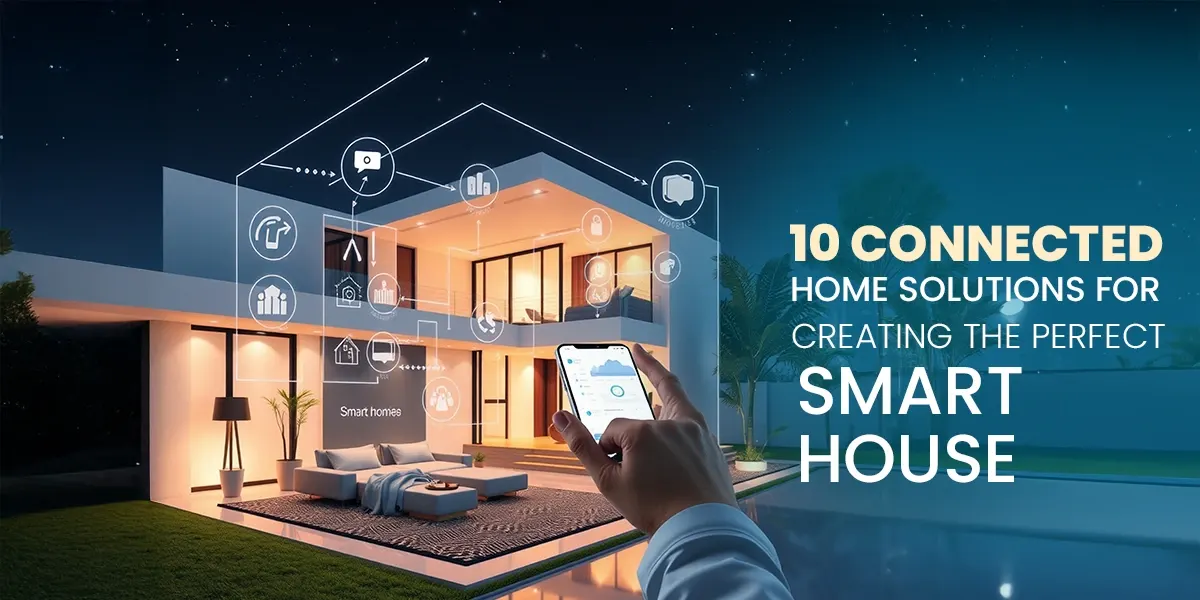
The real smart home is not a house that is made up of one device. It is developed in an inter-networked ecosystem of the most optimal home control devices that are compatible with one another. These systems control the lighting, comfort, security, and energy use on a single platform.
To the homeowners who are planning to have full home automation, the selection of devices is the same as the selection of automation partner. A combination of the correct controllers, switches, sensors, and interfaces ensures stable performance, scalability in the future, and easy day-to-day operation.
At Innexia, every component is designed to integrate into a centralized automation system that delivers reliability, flexibility, and real everyday convenience. Below are the top 10 essential home automation devices that form the foundation of a complete smart home setup.
What Is Smart Home Automation?
Home automation is no longer a futuristic idea. It is the combination of interconnected technologies and smart devices in a home to make a centrally controlled and responsive home.
Homeowners can remotely turn lights on and off, manage climate systems, security cameras, door locks, entertainment systems, and household appliances through internet-enabled devices, sensors, and automation computer programs. The systems work based on centralized platforms or even mobile applications and can be controlled anywhere in real-time.
Artificial intelligence and automation rules also apply in smart home automation, which will automatically perform the task depending on time, occupancy, or user preferences. This lowers the amount of manpower required, enhances energy efficiency, and ensures that there is a uniform level of comfort all over the home.
Top 10 essential home automation devices For Complete Home Automation
1. Central Automation Hub (Controller)
The hub is the brain of the entire system. It manages communication between all connected devices, such as switches, sensors, locks, and control panels.
A reliable automation hub ensures:
- Quick reaction between actions and commands.
- Connectivity of devices in a stable environment, such as Zigbee or Wi-Fi.
- Mobile applications and voice assistants.
Even the most efficient home control devices fail to work as a single system without a powerful central controller.
2. Smart Relay Modules for Existing Switchboards
Behind conventional switchboards, smart relay modules are installed, allowing you to automate lights, fans, and appliances without altering the look of your interiors.
These modules enable:
- Voice and app control of existing electrical points.
- Scenes of scheduling and automation.
- Timed operation for energy saving.
They are suitable for both new building projects and retrofit automation projects.
3. Smart Touch Panels and Wall Controllers
Mobile applications are convenient; nevertheless, wall-mounted control panels provide instant access to the functions of the room without relying on phones.
Smart panels allow:
- Controlling various appliances with a single touch.
- Scene activations of lighting and mood.
- Smooth design that is compatible with a contemporary interior.
They have a significant contribution in enhancing day-to-day usability for the entire family.
4. Scene Controllers and Smart Buttons
Scene controllers, or programmable smart buttons, enable you to tap several actions with one tap.
Common uses include:
- Switching off all the lights in the house.
- Switching on night mode before sleep.
- Alternating between work, relaxation, and entertainment scenes.
Such devices make everyday life much easier and deny the need to rely on mobile applications to take fast-moving actions.
5. Smart Lighting Control Systems
One of the most popular automated processes of any smart house is lighting. Smart lighting modules give the ability to control brightness, color temperature, and timing accurately.
With lighting automation, you can:
- Automatically set brightness depending on the time of day.
- Direct mood-based lighting.
- Minimize power usage by automation.
A major component of a complete home automation system is built-in lighting.
6. Door and Window Sensors
These are small yet powerful sensors that run on real-time data of door and window operations.
They are used for:
- Security alerts and intrusion detection.
- Activating automation when a door opens or closes.
- Remote surveillance of entry points.
Combined with cameras and alarms, the sensors make the camera-based home security automation the first layer.
7. Smart Locks and Access Control Systems
Smart locks give you the benefit of entering your house without a key and having total control of who gains entry and at what time.
Key features include:
- Remote lock and unlock.
- House Key: Guest or Staff Access.
- Connection with security systems and cameras.
Access automation enhances the convenience and security of homes.
8. Climate Control and AC Automation Devices
It is possible to automate air conditioners, heaters, and ventilation systems to keep the comfort and to use less energy.
Smart climate control enables:
- Scheduled automatic temperature adjustment.
- Remote control of AC systems
- Lower power costs by using smart operation.
AC automation is one of the most beneficial automation upgrades to homes located in warm climates.
9. Smart Curtains and Motorized Blinds
Blinds and curtains are automated, which enhances comfort, privacy, and energy savings.
They can be programmed to:
- Open at sunrise and close at sunset.
- Adjust the temperature or sun rays.
- Labor during the morning and evening shifts.
This increases the functionality and beauty of contemporary houses.
10. Security Cameras and Surveillance Integration
Advanced home automation systems include surveillance systems.
When integrated into the automation platform, cameras allow:
- Live tracking using mobile applications.
- Movement-activated notifications and monitoring.
- Connection to door sensors and smart locks.
An integrated surveillance system enhances the total security of the house and gives you a sense of assurance when you are out.
Benefits of Home Automation Solutions
Comfort & Climate Control
- Light, temperature, and curtains automatically adjust.
- Wiser utilization of natural daylighting and less heat indoors.
- Constant comfort during the day, whether or without manual work.
Everyday Convenience
- Turn on or off control lights and appliances througha mobile application or voice activation.
- There is no necessity to use physical switches (tap, tap, etc.).
- The ability to toggle between several functions using a single platform.
Personalized Living Experience
- Scene customizations such as Movie Mode, Night Mode, or Welcome Home.
- One command is used with several devices responding simultaneously.
- Environments that are adjusted to everyday activities and lifestyle.
Remote Monitoring & Control
- You can access your home systems anywhere.
- Switch off the appliances or lock the doors remotely.
- Get notifications of associated security sensors.
Automated Scheduling
- Devices are set to work automatically at preset times.
- Improves the number of daily manual operations and action omissions.
- Maintains the house in line with your schedule.
Conclusion
It takes more than smart gadgets to build a truly connected home. It requires an automation ecosystem that is designed well, where all devices integrate reliably, securely, and efficiently. With Innexia’s advanced range of controllers, switches, sensors, and integrated platforms, homeowners can achieve full home automation that delivers consistent performance, long-term scalability, and simple daily control.
If you are ready to upgrade your living space with a reliable and intelligent automation system, connect with Innexia’s experts today.