
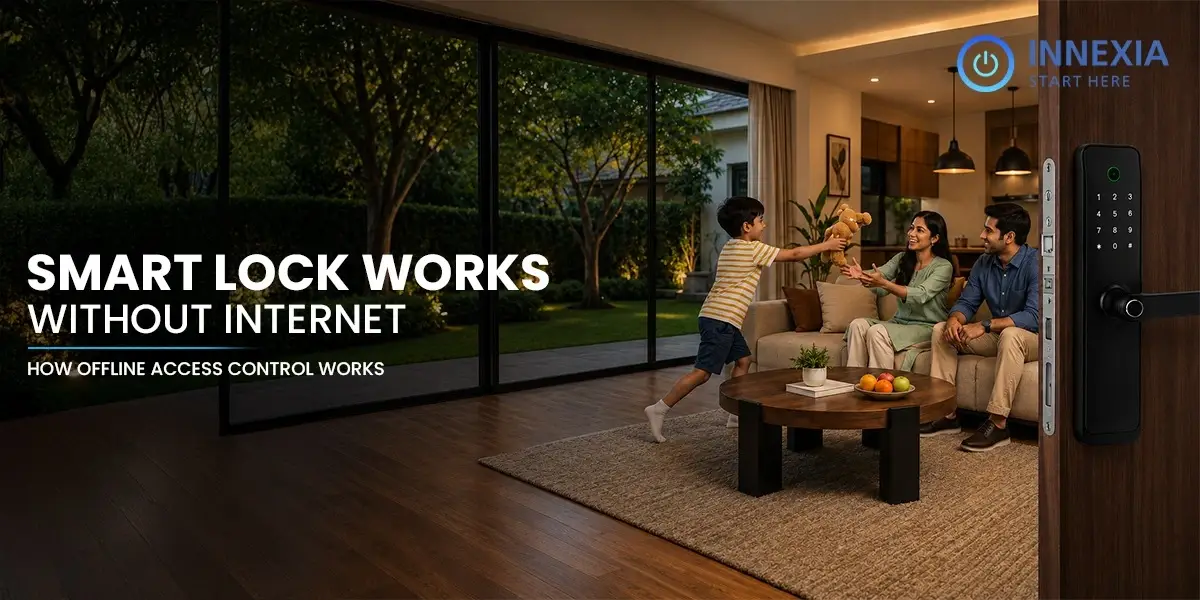
Most people assume a smart lock without internet cannot function. That assumption is wrong, and it matters more in India than anywhere else.
India’s smart lock market was valued at USD 104.5 million in 2025 and is projected to grow at a CAGR of 10.64% through 2034, driven largely by homeowners upgrading from traditional deadbolts to intelligent access systems. But in a country where Wi-Fi drops during heavy rain, power cuts last hours, and router outages are a weekly reality in many cities, a smart door lock security system that stops working the moment the internet goes down is not a smart lock at all.
The good news is that the best smart locks are not designed around internet dependency. They are designed around reliability. This blog explains exactly how offline access control works, what technologies power it, and what to look for before you buy.
Can a Smart Lock Work Without Internet?
Yes. A smart lock works completely for its core function without internet, which is locking and unlocking your door.
Smart Lock: A smart lock is an electronic access device that uses local authentication methods like PIN codes, fingerprints, RFID cards, or Bluetooth smart lock technology to secure access. Internet connectivity is on top of that, but the lock doesn’t need to function.
The Lock has local storage of credentials. The lock checks the data internally when entering the PIN or pressing the finger to the scanner without contacting any server. No internet necessary, no dependence on the cloud, no delay.
The remote features, such as locking the door from a distance, getting alerts as soon as they occur on your phone, and logging activities in the cloud, are all things you’ll miss out on without the Internet. The door still opens. The four main security features remain intact.
Why Offline Access Matters Specifically in Indian Homes
This is not a theoretical concern. It is a daily reality for millions of Indian households.
It’s easy to lose your Internet connection when you lose your power. Frequently, the Internet and power outages go hand in hand. There is no consistency in broadband in Tier 2 and Tier 3 cities. In metros, Wi-Fi routers go down during load shedding, storms, or during the time of maintenance with the ISP. If they are all cloud-dependent, it becomes a liability rather than an asset.
There is also the Indian home layout factor. Thick concrete walls, building-wide network dead zones, and older wiring setups mean Wi-Fi coverage is rarely perfect throughout a home. A lock installed at the main entrance, a back door, or a gate may sit at the edge of your network range.
Offline access control is not a premium feature in the Indian context. It is the baseline requirement for any smart lock worth installing.
What Still Works Without Internet
These access methods function entirely offline, using credentials stored locally on the device itself.
- PIN Code Entry: You type your saved code on the keypad. The lock verifies it internally. Entry takes under two seconds. No app, no phone, no network signal required.
- Fingerprint Recognition: Lock has the fingerprint data stored in it. The biometric verification is not done on a remote server. Typically, unlock time is < 1 second.
- RFID Card or Key Fob: The user taps his/her registered card or fob on the lock. The lock identifies the card and allows or denies access without any Internet verification.
- Physical Key Backup: Most smart locks include a concealed keyhole for mechanical override. This function works with no power, internet connection, or battery when connected to external power.
- Bluetooth Unlock: Unlocks the lock if the phone is within Bluetooth range (normally 5–10 meters) without the need for the Internet. Communication between the lock and phone, without the cloud.
What Requires Internet
These features stop working when your connection drops:
- Remote locking and unlocking from outside your home
- Real-time push notifications and entry alerts on your phone
- Cloud-stored access logs and activity history
- Voice assistant commands via Alexa or Google Home
- Temporary access codes are sent to guests remotely
- OTA firmware updates
Core access is unaffected. Remote management is what requires the connection.
Technologies That Power Offline Smart Locks
Zigbee
Zigbee is a type of mesh protocol that enables direct communication between devices without a Wi-Fi or an internet connection. It is the backbone of our smart home ecosystem. If the internet fails, Zigbee devices will still function with local mesh communication. Your lock is connected to your home system even if it’s offline.
Bluetooth Smart Lock Technology
A Bluetooth smart lock allows your phone to communicate directly with the lock over a short range. No internet gateway is involved. The lock reads your phone’s credentials locally and responds instantly. Its battery consumption is very low, which is one of the most reliable methods to unlock the door remotely without Wi-Fi.
PIN and Keypad
Stored directly on the lock’s internal memory. The lock can validate codes autonomously, without depending on another party’s authorization. When used in combination with battery backup, it’s reliable even in total power outages.
Biometric Authentication
Fingerprint data is encrypted and stored locally within the lock’s secure memory. Recognition happens on-device. No cloud server is involved in the verification process at any point, which strengthens smart door lock security rather than weakening it.
Technology | Requires Internet | Range | Battery Impact | Offline Reliable |
Zigbee | No | Mesh network wide | Very Low | Yes |
Bluetooth BLE | No | 5 to 10 metres | Low | Yes |
PIN Code | No | Direct keypad | None | Yes |
Fingerprint | No | Direct contact | None | Yes |
Wi-Fi | Yes | Router range | High | No |
How Innexia Handles Offline Access
We use Zigbee mesh technology so that our system doesn’t require your internet connection to operate. If your WiFi drops out, the Zigbee mesh will maintain a local connection to the Innexia hub and keep your lock connected. When your Wi-Fi goes down, the Zigbee mesh keeps your lock connected to the Innexia hub locally. Schedules still run. Scenes still activate. Access logs are stored on the device and sync when connectivity resumes.
The lock provides a number of access methods at the same time: PIN code, fingerprint, RFID card, and physical key backup. Each method is working independently, so if one doesn’t work, another 3 do.
This is a deliberate design decision rooted in smart door lock security principles. In Indian homes where connectivity is variable and power cuts are common, a locally-first architecture is the only responsible way to build an internet-free smart lock.
Conclusion
A lock that only works when the internet works is not a security solution. The right system uses offline access control protocols, stores credentials locally, and keeps your door accessible regardless of what your broadband is doing.
At Innexia, our smart automation works without internet dependency and is built on Zigbee, backed by biometric and PIN access, and designed specifically for how Indian homes actually operate.
Upgrade to an internet-free smart home today. Book a free demo and experience the difference firsthand.